

Reading Options
These options change this article. You can also use your browser’s zoom.
GAMES · 6 MIN READ
RTP, Volatility, and Hit Frequency Explained
By Gigi Celeste RTP, Volatility & Hit Frequency

Quick Answers
- RTP is a game’s expected return over a very large amount of play. It does not promise your session’s return.
- Volatility describes how widely results can vary. Hit frequency describes how often a defined result happens.
- Check the exact game version and each number’s meaning. Two games can share an RTP and still have very different results.
From Gigi’s Preflight Notes
The Average Flight Nobody Flew
In Aurelia’s gear bay, an instructor showed me one average calculated from several flight-armor trials. The number looked wonderfully steady. Then she opened the individual flight records. Some trials had been smooth, while others had been considerably less graceful.
I asked which pilot had flown the average flight. None of them had. The number summarized all the trials; it was not a replay of one flight, and it certainly was not a preview of mine. Perfectly accurate and completely unwilling to predict my future. A little rude, but useful.
RTP, volatility, and hit frequency work in a similar way. Each describes a different part of a game’s design, but none can tell you what the next result will be.
Three Terms in Plain Words
| Term | What it describes | What it cannot tell you |
|---|---|---|
| RTP | The expected return across a very large amount of play. | Your balance at the end of a session. |
| Volatility | How widely results vary. | When a certain result will happen. |
| Hit frequency | How often a defined result happens. | How much each hit will be worth. |
A number needs a clear label. Check what is being measured and which game version it covers.
What Does RTP Mean?
RTP stands for return to player. It compares the expected amount returned with the total amount used in play. Game makers can work it out through math or large tests of the game model. [1]
Here is an example using Gold Coins (GC), our coins for fun. A 90% RTP does not mean a starting balance of 100 GC must end at 90 GC. RTP uses the total put through rounds. If you use coins from earlier results again, that total can be higher than your starting balance.
Theoretical RTP means the rate expected from the game’s design over a very large amount of play. Actual RTP describes what happened during a measured period. That period’s result can differ from the design rate. [2]
What Does Volatility Mean?
Volatility describes how much results can vary. A game with wider swings may put more of its expected return into rare, larger results. Another may use more frequent, smaller results. [2]
Labels such as low, medium, and high need context. One game maker’s “medium” may not mean the same thing as another’s.
Low volatility does not promise a smooth session. High volatility does not mean a larger result is on its way. Neither label changes the limits you chose.
What Counts as a Hit?
Hit frequency tells you how often a defined event occurs. First find what that game counts as a hit.
-
- Check whether a hit means any coins returned, a symbol group, or a certain minimum result.
- Check whether the number covers all hits or only a feature trigger.
- Find what is counted: whole rounds, feature spins, or each cascade.
- Check whether the rate comes from the game model, a test, or past records.
- Make sure it covers the game version you opened.
A hit can return fewer coins than the round used. For example, a round may use 2 GC and return 1 GC. If any return counts as a hit, that result is a hit even though it did not return all 2 GC.
Gigi’s Field Note
Name the Reading Before Using It
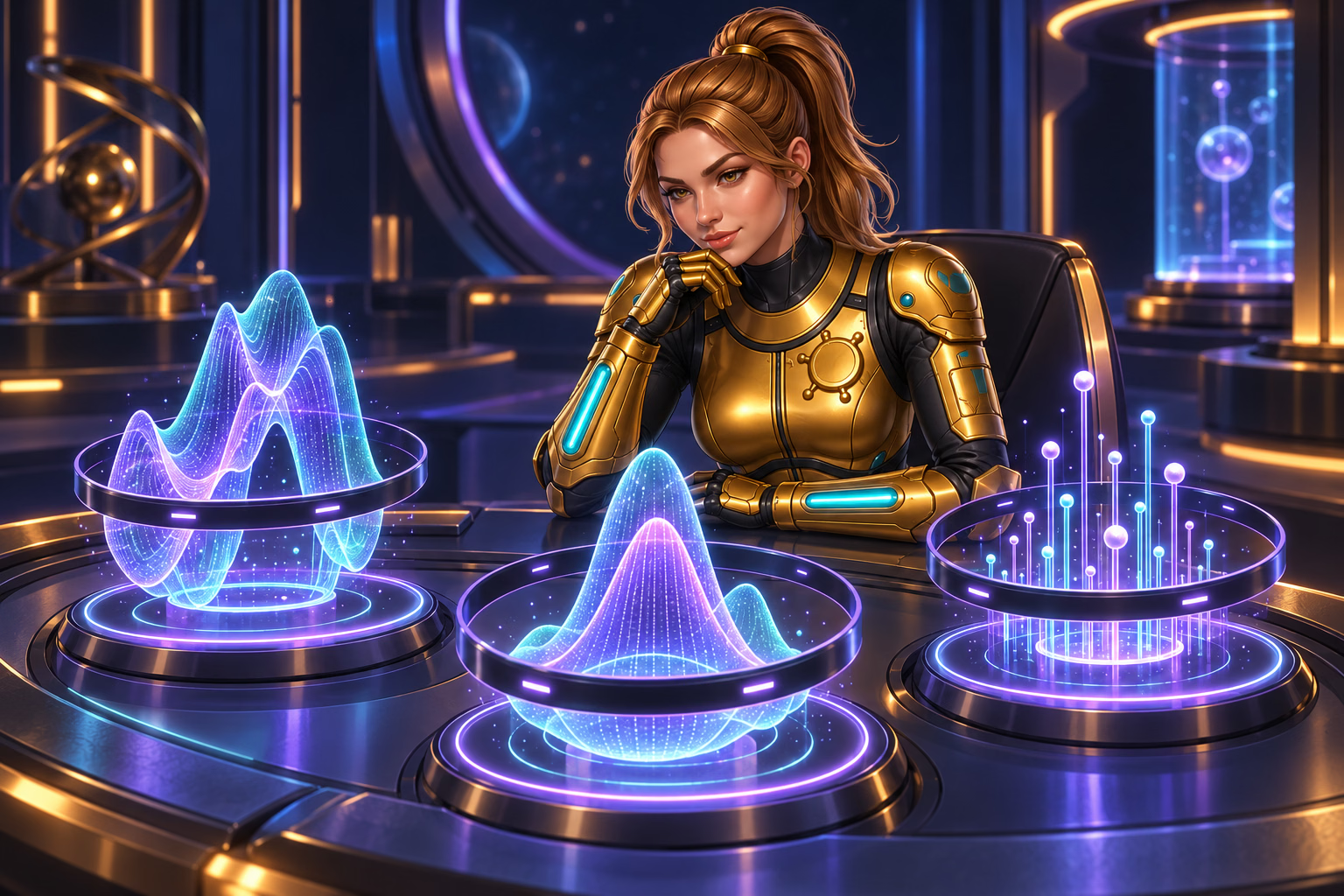
In the gear bay, I gave each display a plain label: average, swings, and event count. Then my instructor pointed to the empty space reserved for the next flight’s result. The existing numbers could describe the earlier trials, but none could fill in that blank.
It was a useful lesson. It was also the end of my very brief plan to make the displays do all my thinking for me.
Same RTP, Different Pattern
Here are two made-up game models. Each round uses 1 GC. Each has 100 equally likely possible outcomes. Keep in mind, these are just examples, not actual Win Bonanza game figures.
| Model | Outcomes that return coins | Other outcomes | Expected return per round |
|---|---|---|---|
| A | 50 return 1.8 GC each. | 50 return 0 GC. | 0.90 GC |
| B | 5 return 18 GC each. | 95 return 0 GC. | 0.90 GC |
- For A, the math is 50 ÷ 100 × 1.8 GC = 0.90 GC.
- For B, it is 5 ÷ 100 × 18 GC = 0.90 GC.
- Both return an expected 90% of the 1 GC used per round.
If any return counts as a hit, A has a 50% hit rate. B has a 5% hit rate and much wider swings. The average is the same; the pattern differs.
These are 100 possible outcomes for each round. They do not promise those exact counts in the next 100 rounds. Playing longer does not make your session match the example.
Check the Version You Opened
A game maker may offer several RTP settings for one game. A figure on another site may not match the version you are using. Some game makers list several settings and tell players to check the game’s own information. [3]
Open the game through All Games. Note its name, maker, version, and any numbers shown. If a figure or its meaning is missing, ask Mission Control, our support team. Do not guess it from a few recent rounds.
Our game choice guide also looks at clear rules, pace, and screen comfort.
Understand What a Game Number Measures
-
Define the Number
Check what it measures, what it counts, and what total it uses.
-
Check the Details
Use each game’s exact version, settings, and definitions when you compare.
-
Read It in Context
Use it to compare game design. It cannot predict your session or the next round.
Keep Numbers and Predictions Separate
RTP is not a session target. Volatility is not a timer. Hit frequency is not a schedule. A meter that saves progress still follows its own game rule.
Our Hold and Win guide shows how a board can track progress without promising it will fill. Keep your time and coin limits outside the math.
Use the Number for the Right Job
The flight average became useful once I stopped asking it to predict my landing. Read game numbers with the same limit. Learn what each one measures, compare the correct game versions, and leave the next result where it belongs: unknown.
Your Next Step
Check the game’s own numbers, definitions, and version.
Frequently Asked Questions
- Does RTP predict what I will get back in one session?
-
No. RTP describes an expected return over a very large amount of play. It does not promise the result of your session.
- What is the difference between volatility and hit frequency?
-
Volatility describes how widely results can vary. Hit frequency describes how often a defined event happens. Check what the game counts as a hit before comparing numbers.
- Can a hit return fewer coins than a round used?
-
Yes. A game may count any return as a hit. For example, a round that uses 2 GC and returns 1 GC may still count as a hit under that definition.
- Can two games with the same RTP feel different?
-
Yes. They can spread their results differently, with different frequencies and sizes of returns. Matching RTP figures do not mean matching session results.
Sources
Sources checked September 8, 2026. Rules and offers can change. Open the links below to read the full details.
- Gaming Laboratories International: RTP Analysis
How game RTP can be calculated or tested. This does not give the RTP of a Win Bonanza game. - UK Gambling Commission: RTP and Volatility Definitions
Definitions of RTP and volatility. This source explains the terms; it does not set our site rules. - Push Gaming: Jammin’ Jars 2
A game maker’s example with several RTP settings. Games offered on our site may differ. - Win Bonanza All Games
Browse our games and open each game’s own rules.
FROM THE EDITORIAL DESK
Trust and Transparency
Written by Ella Hartly in the voice of Gigi Celeste, a Win Bonanza Crew character.
Ella Hartly built the Win Bonanza Crew around one idea: facts help more when people enjoy reading them. Her characters use stories and humor to make hard topics easier to follow. The facts about Win Bonanza come from the sources linked above.
Win Bonanza publishes these guides about our own service. The crew’s adventures are part of our story world and are entirely fictional. Ella Hartly is the real expert behind these characters, offering her insights and expert opinion.
Win Bonanza’s editorial process calls for checking sources, claims and links before publication and when rules change. Ella Hartly’s personal opinions and game preferences do not reflect the opinions of the brand Win Bonanza.